 +994512060920


Every team starting a new project runs into the same question sooner or later: write the code as one unified system, or split it into small, independent services from day one? The question sounds simple, but the answer shapes the project's future. Some teams build a dozen microservices for an MVP that doesn't even have its first customer yet, and burn months on infrastructure instead of the product. Others go from a thousand users to a million still running a single, sprawling codebase, where every small change puts the whole system at risk.
Picking the right architecture isn't about going with whatever's trending. In this article, we'll walk through the real differences between monolithic and microservices architecture, the strengths and weaknesses of each, and how to figure out which one actually makes sense for your project.
What Is a Monolithic Architecture?
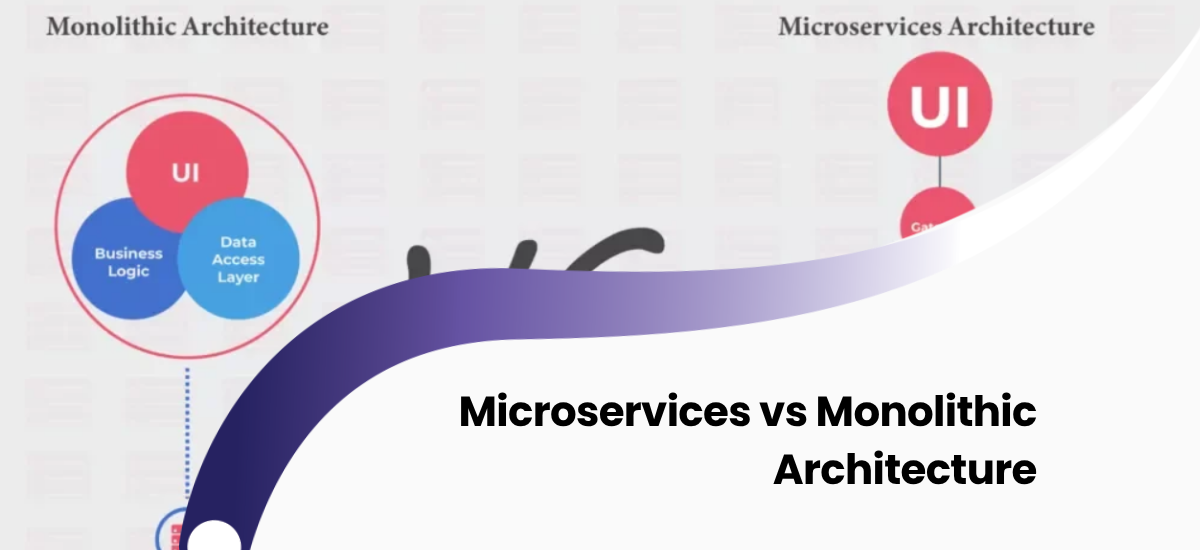
In a monolithic architecture, the entire application — the user interface, business logic, and database access — is written as a single codebase, built as one application, and deployed as a whole. User registration, payments, notifications: it all runs inside the same project, on the same server.
This is the traditional, most common approach to building software. For small teams, startups, and early-stage products, monolithic is essentially the default choice — simply because it's easier to start and easier to build on.
What Is a Microservices Architecture?
In a microservices architecture, the application is split into small, independent services. Each microservice owns a specific piece of responsibility — one service might handle only user authentication, another only payments, a third only sending notifications. These services typically talk to each other through APIs, and each one can be deployed on its own, scaled on its own, and even written in a different programming language.
Large platforms like Netflix, Amazon, and Uber run on this model, because their systems serve millions of users at once, and a problem in one service can't be allowed to take down everything else.
Key Differences Between Microservices and Monolithic Architecture
| Criteria | Monolithic | Microservices |
|---|---|---|
| Code structure | Single, unified codebase | Multiple, independent codebases |
| Deployment | The whole system deploys together | Each service deploys on its own |
| Scalability | The whole system scales together | Only the loaded service scales |
| Team structure | One team owns the whole system | Each team owns its own service |
| Time to get started | Fast | Slower, requires extra infrastructure |
| Impact of failure | One bug can bring down the entire system | A failure usually stays contained to one service |
| Monitoring | Simple — it's one system | Complex — many services to track |
Advantages of Monolithic Architecture
- Simple to start: One repository, one deployment process, one test environment — the team spends its time on the product, not on infrastructure.
- Lower upfront cost: No need for separate servers, container orchestration, or complex monitoring setups.
- Easier to debug: With all the code in one place, tracking down and fixing a problem is far more straightforward.
- Faster team collaboration: In a small team, everyone understands the whole system, so there's no need to coordinate across separate services.
Drawbacks of Monolithic Architecture
- Scaling problems: Even if only one part of the system is under heavy load — say, the payments module — you still have to scale the entire application.
- Gets harder to build on as it grows: As the codebase grows, adding new features, understanding the existing code, and making changes all get progressively harder.
- Risky deployments: Even a small change requires redeploying the entire system, which raises the risk of something breaking.
- Limited technology choices: Since the whole system is built with one language and one framework, you can't pick different technologies for different parts.
Advantages of Microservices
- Independent scaling: You only need to scale the service under load, not the whole system — which means real savings on resources.
- Isolated failures: A problem in one service usually doesn't stop the others from working.
- Independent deployment: A team can deploy its own service without waiting on anyone else, even several times a day.
- Freedom of technology: Each service can be built with whatever programming language and database fits its own needs.
- Parallel work for large teams: Different teams can work on their own services without touching each other's code.
Drawbacks of Microservices
- High complexity: Tracking, debugging, and managing how dozens of services talk to each other takes real, hard-won experience.
- Expensive infrastructure: Every service needs its own server, monitoring, and CI/CD pipeline.
- Network dependency: Since services communicate over the network, you're exposed to latency and connectivity issues.
- Requires an experienced team: For a team with no experience running distributed systems, this architecture can turn into more headache than benefit.
The Impact on Testing and CI/CD
Your choice of architecture doesn't just affect how the code is written — it directly shapes how the team tests and ships it. With a monolith, a single CI/CD pipeline is enough: code is pushed to the repository, the whole system is tested together, and it's deployed all at once. That's simple to set up, but as the system grows, each deployment turns into a longer and longer process.
In a microservices setup, every service gets its own CI/CD pipeline. That gives teams speed and independence, but it also means managing dozens of separate pipelines, testing compatibility across services, and tracking which version of each service is running where — all of which takes extra tooling and experience. If your team is still early in its CI/CD journey, managing a few dozen pipelines at once will just add extra overhead.
Which Architecture Fits Which Project?
There's no single right answer to this — it depends on your project's stage, your team's size, and your budget.
Go with a monolith if: your project is still at the MVP stage, your team is smaller than 5-10 people, your budget is tight, or you're not yet sure which direction the product will take. If getting to market fast matters most, a monolith will get you there sooner.
Go with microservices if: your user base is already large and growing steadily, your team is big enough to split into several parallel teams, different parts of the system need to scale at different rates, or you genuinely need different technologies for different parts of the system.
How to Migrate from Monolith to Microservices
Most successful companies — Amazon and Netflix among them — started with a monolith and moved to microservices later, not the other way around. That's not a coincidence: proving the product works in the market first, then evolving the architecture as you grow, is simply the smarter strategy.
The migration is usually gradual. The part of the monolith under the heaviest load and with the clearest boundaries — a notification system or a payments module, for instance — gets pulled out into its own service first. Once that service is stable, the next module gets separated the same way. This approach avoids rewriting the whole system at once and keeps the risk to a minimum.
The Most Common Mistake: Moving to Microservices Too Early
A lot of teams pick microservices because it feels more "modern," not because they actually need it. The result is what's known as a "distributed monolith" — the system is technically split into separate services, but those services are so tightly coupled that changing one means changing the others too. You end up losing every benefit of microservices while keeping all of its complexity.
So before deciding, the real question is: can your team and your product actually handle the operational load that microservices bring right now? If the answer is no, starting with a monolith and migrating gradually as you grow is the right call.
Frequently Asked Questions
Which architecture is better for a small startup?
Almost always a monolith. Fast development and low cost matter more at the startup stage than anything microservices can offer.
When is it time to move to microservices?
When your user count is growing fast, your team is scaling up, and specific parts of the monolith start seeing far heavier load than the rest.
Are microservices always better than a monolith?
No. Microservices give you more flexible scaling, but in exchange you take on more operational complexity and infrastructure cost. What's "better" depends entirely on the project.
Can you use both approaches together?
Yes. Many companies use an in-between approach called a "modular monolith" — the code is organized into clearly separated modules internally, but still deployed as a single application. This makes a future move to microservices much easier.
Conclusion
The choice between monolithic and microservices architecture isn't a matter of ideology — it's a practical decision. For a small team, a monolith gives you speed and simplicity; for a large, fast-growing system, microservices give you flexibility and independent scaling. The biggest mistake, in either direction, is picking your architecture based on a trend instead of an actual need.
If you're not sure which architecture makes sense for your project, you can reach out to the Crocusoft team for technical advice suited to your project's size and goals.