 +994512060920


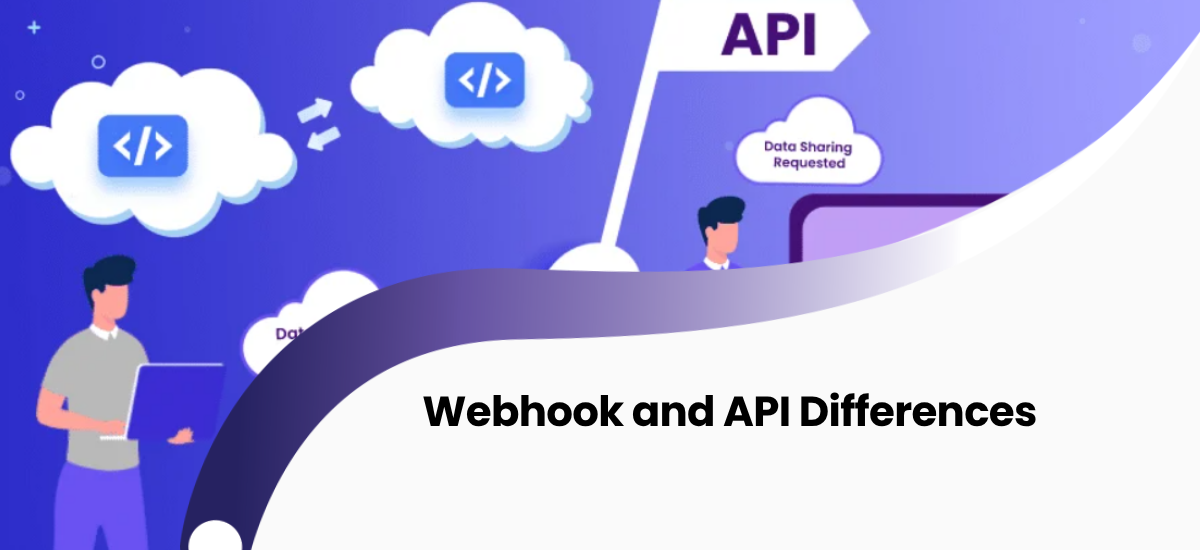
The greatest strength of modern software applications lies in their ability to integrate seamlessly with one another. Whether connecting your e-commerce site to a payment gateway, your customer relationship management (CRM) system to marketing tools, or your mobile app to external cloud services, reliable communication is essential. There are two primary technical methods for building this data exchange and system integration: API (Application Programming Interface) and Webhook.
Both technologies serve the same global goal—enabling data transfer between disparate systems. However, their underlying logic (architecture) is completely different. As a software development company, we always emphasize in our projects that choosing the right integration method directly impacts server performance (load optimization), cloud infrastructure costs, and system scalability.
What is an API? (Request-Response Architecture)
An API (typically implemented via REST or GraphQL) is a defined set of rules that allows two programs to communicate with each other. APIs follow a standard Request-Response model. In other words, unless your client system requests data, the server sends nothing.
If you want to check whether a specific event has occurred using an API, you must use Polling (continual querying). This means constantly asking the system, "Has the data updated? How about now?", which unnecessarily increases network traffic and server load.
Technical Processing Flow:
- System A (Client) sends an HTTP request (GET, POST, PUT, DELETE) to the API endpoint of Server System (System B).
- System B receives the request, validates authentication and authorization, and performs the required database operation.
- System B returns the resulting payload in JSON or XML format along with a proper HTTP status code (e.g., 200 OK, 404 Not Found, 500 Server Error).
- System A receives the response and processes it within its interface.
What is a Webhook? (Event-Driven Architecture)
A Webhook is often referred to by developers as a Reverse API or HTTP Push API. Webhooks are event-driven. Here, you don't need to continually query the counterparty (Polling) to learn about data changes. The moment a specific event (Trigger) occurs, the system automatically pushes the data directly to your server endpoint.
If an API is like repeatedly calling a waiter to ask "Is my food ready?", a Webhook is like the waiter bringing the food straight to your table the exact moment it is prepared, without any prompting.
Technical Processing Flow:
- A predefined event (e.g.,
payment_successoruser_registered) occurs in System B. - System B immediately sends an HTTP POST request containing the data payload to System A's pre-configured Webhook URL (Endpoint).
- System A receives the data and promptly returns a 2xx status code (e.g., 200 OK or 202 Accepted)—ideally within 1–3 seconds—so the sender doesn't encounter a timeout error.
- Heavier data processing and storage operations continue asynchronously in the background on System A's side.
Technical Comparison: Polling (API) vs. Push (Webhook)
| Technical Criterion | API (Polling / Pull) | Webhook (Event-Driven / Push) |
|---|---|---|
| Communication Initiator | Client (The system requesting data) | Server (The system where the event occurs) |
| Data Update Frequency | Depends on your cron job or loop interval settings. | Real-time – Within milliseconds of the event occurring. |
| Server Resources & Load | 🔴 High (Even empty requests consume TCP connections and CPU cycles). | 🟢 Very Low (HTTP requests are only sent when an action occurs). |
| Architecture Type | Synchronous (mostly) – Expects an immediate response. | Asynchronous (Fire-and-forget) – Dispatches data and finishes. |
| Error Handling | 🟢 Easy. If a request fails, retrying is entirely under your control. | 🔴 Challenging. If your server goes down, you might miss incoming packets. |
| Security Standards | Protected via API Keys, OAuth 2.0, or Bearer Tokens. | Requires HMAC signatures and IP whitelisting. |
When is an API the Right Choice?
An API should be used when:- You need specific data retrieval: For example, "Fetch only the email address of the user with ID 456" (GET request).
- You need to perform CRUD operations: When you want to create (POST), update (PUT/PATCH), or delete (DELETE) data in a database.
- Two-way or sequential interaction is required: When a subsequent logical action depends directly on the result of the previous request.
- You want to control data volume: Using pagination algorithms to fetch tens of thousands of records in controlled batches without straining the server.
When is a Webhook the Right Choice?
Webhooks perform exceptionally well in Event-Driven microservices architectures:- Real-time synchronization is critical: When payment gateways (Stripe, PayPal, etc.) notify your system the moment a card is charged so services can activate instantly.
- Listening to third-party platforms: Triggering CI/CD pipelines when code is pushed to GitHub, or routing incoming messages to your internal system via the WhatsApp Business API.
- Preventing rate limits and resource waste: If an API provider imposes a strict rate limit (e.g., 60 requests per minute), setting up a Webhook listener instead of constant polling is the smartest engineering decision.
System Architecture: Webhook Challenges and Professional Solutions
As a software development company, we proactively solve three critical technical challenges when designing Webhook architectures:1. Delivery Guarantee Issue
If your receiving server (Endpoint) happens to be restarting or experiencing network downtime at that exact moment, the Webhook packet could be lost.
Engineering Solution: Implement an Exponential Backoff retry mechanism on the sending side. If delivery fails, the system should retry at progressively longer intervals (e.g., 1 min, 5 min, 15 min, 1 hour). Additionally, on the receiving side, incoming Webhooks should be routed to a Message Broker queue (such as RabbitMQ, Kafka, or Redis) rather than written directly to the database.
2. Idempotency (Managing Duplicate Events)
Due to temporary network dropouts, the sending party might not receive your "200 OK" acknowledgment and may transmit the same event (e.g., a $50 payment) to you a second time.
Engineering Solution: Every Webhook payload should include a unique event identifier in its header (e.g., X-Event-ID). Your system must check whether this ID has already been processed before executing business logic.
3. Security and Data Integrity (HMAC Signatures)
Because your Webhook endpoint is publicly accessible, malicious actors could flood your system with forged POST requests claiming false events (e.g., "payment completed").
Engineering Solution: Use Webhook Signatures. The sending system cryptographically signs the payload using a secret key (e.g., via HMAC-SHA256) and includes it in an HTTP header (e.g., X-Signature). The receiving server must validate this signature before accepting the payload for internal processing.
Most Common Integration Scenarios
| Integration Scenario | Recommended Architecture | Technical Reason |
|---|---|---|
| New message arriving from a messaging app to your CRM | Event-Driven Webhook | Requires live, instantaneous response with zero tolerance for delays. |
| Checking product stock in an ERP/inventory system from an e-commerce site | REST/GraphQL API (Pull) | Exact stock numbers must be queried precisely at checkout before ordering. |
| Customer completing an online payment gateway transaction | Webhook (Push) | The process happens externally and must notify your system upon completion. |
| Mobile frontend app fetching a news feed from the backend | API (with Pagination) | Data is fetched in specific batches as the user scrolls. |
The Ultimate Software Solution: The Hybrid Model
In complex software development projects, the most ideal engineering practice is a hybrid approach combining both technologies. Example: Complex CRM and Payment Integration scenario:- Notification Phase: The external payment gateway sends a lightweight Webhook to your system stating, "Payment ID 1024 has been successfully completed."
- Verification Phase: For security reasons, your system does not blindly trust the notification. It immediately triggers an API request back to the payment provider's server (e.g.,
GET /payments/1024). - Final Result: The API verifies the transaction, retrieves additional details (customer bank, commission fees, etc.), and your software safely finalizes the order.
Frequently Asked Technical Questions (FAQ)
What is the difference between REST API and GraphQL, and do they relate to Webhooks?
REST APIs require separate endpoints for each resource type (e.g., /users, /orders) and can sometimes suffer from over-fetching data. GraphQL operates through a single endpoint (/graphql) allowing you to request precisely the fields you need. Both are "Pull" methods. Webhooks are an entirely different concept—they represent a "Push" mechanism.
Is setting up a Webhook endpoint difficult?
Writing the base code to handle a POST request takes only a few minutes. However, incorporating signature validation, idempotency guards, and message queue systems (RabbitMQ/Redis) requires professional software engineering expertise.
How can I easily test webhooks in my local development environment?
When working on localhost, tools like ngrok are widely used by developers to expose local endpoints to external webhooks. Additionally, platforms like Webhook.site let you visually inspect and analyze incoming HTTP payloads from third-party apps without writing any code.
Conclusion
From a technical standpoint: APIs pull data on demand, while Webhooks push notifications when events occur.
If your application requires user-interface driven actions, internal searches, or sequential operational workflows, the correct architecture is an API. If you need to react instantly (in real time) to external events—such as payments, messages, or registrations—and dramatically reduce server load, Webhooks are indispensable.
Whether you are building enterprise-grade software or integrating existing platforms (ERP, CRM, E-commerce) seamlessly, professional engineering makes all the difference. Contact the team and let's design the ideal technical architecture for your project.