 +994512060920


A customer reaches out to your company's chatbot: "What are the warranty terms for this product?" The chatbot answers in a highly confident tone—but the information it provides reflects the terms from 2024, even though your company completely updated its warranty policy in 2026. Even worse, the system might produce completely fabricated, unrealistic answers (hallucinations).
This is the weakest point of traditional artificial intelligence (AI) models: after the initial training phase, the model is blind to recent updates and completely unaware of your company's internal, confidential documents. In the world of enterprise digital transformation, RAG has emerged to solve this exact problem at its core.
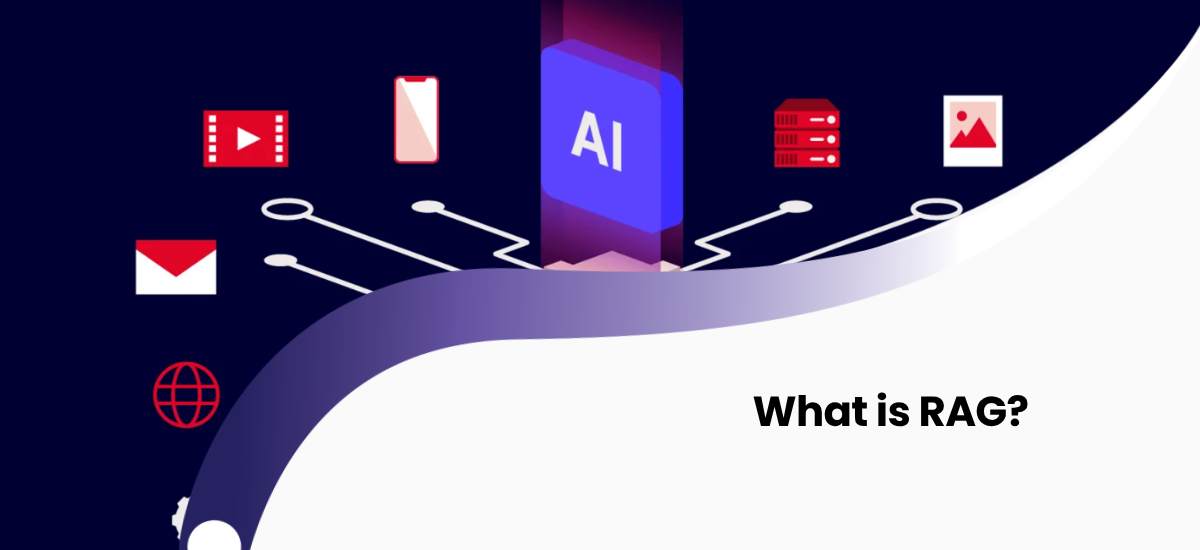
What is RAG?
RAG stands for Retrieval-Augmented Generation. In the simplest terms: before an AI model responds to a user, it conducts a quick search within an internal database, finds the relevant facts, and formulates a response based strictly on those real-world inputs.
The process happens in 3 agile steps:
- Query Input: The user asks a specific question.
- Retrieval: The system scans your company's secure document repository and extracts the most relevant text snippets within seconds.
- Generation: The AI model reads these up-to-date documents and crafts a flawless, context-aware answer.
As a result, the artificial intelligence relies on your company's real, live knowledge base rather than outdated "guesses" from its training memory.
What Happens Without RAG Technology?
A standard Large Language Model (LLM) only holds global data up to its training cutoff date. In a business environment, this blind spot creates three massive risks:
- Information Obsolescence: The model remains completely unaware of internal operational changes made just yesterday.
- Lack of Company Specificity: By default, a generic model cannot access your commercial contracts, unique operational procedures, or internal HR guidelines.
- Hallucination (Fabrication): Instead of saying "I don't know" when facing unfamiliar topics, AI often manufactures highly believable false information.
The RAG architecture closes these gaps, transforming standard models into a secure and dependable AI enterprise solution.
How RAG Works: The Technical Behind-the-Scenes
Step 1: Document Vectorization (Embedding)
All company documents—PDF contracts, Word procedures, Excel product catalogs, FAQ pages, and internal memos—are converted into digital vectors (mathematical coordinates) by a specialized embedding model. These coordinates measure the actual meaning of the sentences rather than just matching exact words. Consequently, text snippets with similar semantic meanings sit close to each other in a mathematical space.
Step 2: Storage in a Vector Database
These converted mathematical data are stored in structured vector databases (such as Pinecone, Weaviate, or pgvector). This infrastructure differs from traditional SQL databases because searches are performed directly based on "context and meaning" rather than keyword matches.
Step 3: Semantic Search on Query Input
When a user submits a question, that query is instantly converted into a vector using the same embedding model. The system queries the vector database to filter out the document chunks that are closest in meaning to the question.
Step 4: Context-Enriched Generation
The retrieved document chunks are passed to the LLM as a brief: "Answer the user's question based strictly on this provided context." The model stops being overly creative and extracts an accurate answer while remaining fully faithful to the source document.
RAG vs. Fine-Tuning: What is the Difference?
| Criterion | RAG (Retrieval-Augmented Generation) | Fine-Tuning (Model Re-Training) |
|---|---|---|
| Data Updates | 🟢 Extremely easy — Drop a new document into the database, and it reads it instantly. | 🔴 Difficult — You must re-train the model every time new data is introduced. |
| Infrastructure Cost | 🟢 Low — Existing cloud or local databases are sufficient. | 🔴 High — Requires powerful GPU resources and significant time. |
| Transparency & Audit | 🟢 High — It shows exactly which document and page the answer was drawn from. | 🔴 Low — It is impossible to track why the model generated an answer within its neural networks. |
| Hallucination Risk | 🟢 Minimum — Because it relies strictly on the provided text reference. | 🟡 Medium — The model can still mix up legacy data points. |
| Implementation Time | 🟢 Fast — Can be built and deployed within days or weeks. | 🔴 Long — Data cleaning, training, and testing can take months. |
| Most Effective Area | Dynamic documents and frequently changing internal databases. | Adjusting the conversational tone or mastering highly specific industry terminology. |
Real-World Business Applications of RAG Technology
1. Customer Service and Support Systems
When a customer reaches out, the RAG system finds the most accurate clause among internal FAQs, corporate warranty terms, and active product catalogs. The AI structures its response solely within this boundary. For instance, in the Topaz CRM project developed by Crocusoft, customer service agents draw real-time data from a massive client history database using these exact fundamental principles.
2. Corporate Internal Knowledge Base (AI HR & Legal)
When a new employee asks about internal company procedures, RAG scans thousands of archived files to locate the correct paragraph: "According to section 4 of our HR policy, your...". This approach automatically resolves 60-70% of routine internal inquiries heading to HR and legal departments.
3. Contract and Legal Document Analytics
When legal teams inquire about specific risks within a clause, RAG scans hundreds of executed contracts to find similar precedents and discrepancies, presenting them in a comparative analytical report.
4. Technical Support and Incident Management
When engineers encounter system errors, RAG runs a semantic search across past error logs, technical documentation, and historic resolutions to suggest immediate troubleshooting steps. This type of automation slashes tier-1 support costs by 40-60%.
Core Components of RAG Architecture
| Component | Role in the Process | Popular Industry Tools |
|---|---|---|
| Document Loader | Reads and digitalizes files from various formats (PDF, Word, Excel, HTML). | LangChain, LlamaIndex |
| Text Splitter | Breaks large documents into smaller chunks without losing semantic context. | Recursive Character, Semantic Chunking |
| Embedding Model | Converts each text chunk into a high-dimensional mathematical vector. | OpenAI Embeddings, Cohere, HuggingFace local models |
| Vector Database | Indexes, secures, and rapidly searches millions of complex vectors. | Pinecone, Weaviate, Milvus, pgvector |
| LLM (Core Model) | Translates the retrieved document context into natural, human-readable answers. | Claude 3.5 Sonnet, GPT-4o, Llama 3 |
What Are the Limitations of RAG Systems?
While highly powerful, there are real operational challenges you must consider when deploying RAG:
- Direct Dependency on Data Quality: The system runs on the "Garbage in, garbage out" principle. If your internal documentation is unorganized, outdated, or contradictory, the AI's output will reflect those exact flaws.
- Context Loss (The Chunking Problem): If documents are split incorrectly during the processing stage, the beginning of a sentence might land in one chunk while the end lands in another, occasionally distorting the core meaning.
- Latency: Because an extra database search step is executed before every single generation, response times can be a few seconds longer compared to standard standalone models.
Addressing Multi-Language and Localized Data Challenges
Building an AI knowledge base for companies operating in regional or multilingual environments requires extra care:
- Language Semantics: Many standard embedding models struggle to capture the complex syntax of regional languages deeply. Choosing advanced multilingual models (such as multilingual-e5) is crucial for cross-border data accuracy.
- Alphabet and Encoding Discrepancies: Mixed character sets or historical document encodings found in archived company files must be cleaned and normalized during the preprocessing phase.
- Hybrid Corporate Terminology: Seamlessly grouping and processing business documents that mix local terms with English or global corporate jargon is essential for accurate retrieval.
At Crocusoft, we engineer secure, custom custom RAG solutions tailored to your specific linguistic, business, and data environment.
Frequently Asked Questions
How long does it take to implement a RAG system?
Developing a basic RAG prototype takes about 1–2 weeks. However, building a production-ready, highly secure, and scalable system fully integrated with your company's internal software usually takes 4–8 weeks.
Are our internal company documents safe when using RAG?
Yes. When deploying a completely self-hosted, on-premise RAG infrastructure, your data never leaves your company's internal servers. For handling highly sensitive and critical corporate data, a custom-built custom software architecture is always recommended over generic public platforms.
Can RAG systems be combined with AI Agent workflows?
Yes, and this is actually the most powerful combination in modern automation. The AI Agent acts as the decision-making "brain" running the process, while RAG serves as the secure corporate library, feeding the agent the exact rəsmi (official) records it needs at every step.
Conclusion
RAG represents one of the most practical and effective AI breakthroughs for enterprise operations. It minimizes the risk of AI fabrications, anchors workflows to your real intellectual property, and keeps information continuously updated. Without purchasing expensive generic SaaS licenses or spending massive budgets on retraining baseline models, you can build a proprietary AI ecosystem simply by routing your internal sənədlər (documents) through a secure RAG architecture.
Ready to transform your company's documentation into an intelligent assistant and set up real workflow automation? Get a free technical consultation from Crocusoft experts today →